Foundation Drainage & Grading in Orlando, FL

Downspouts dumping at the slab, sprinklers soaking the foundation or sand washing out at the edge? Here is how drainage and grading fixes protect slab homes on Central Florida sand.

Get a Free Quote Call (727) 300-6656
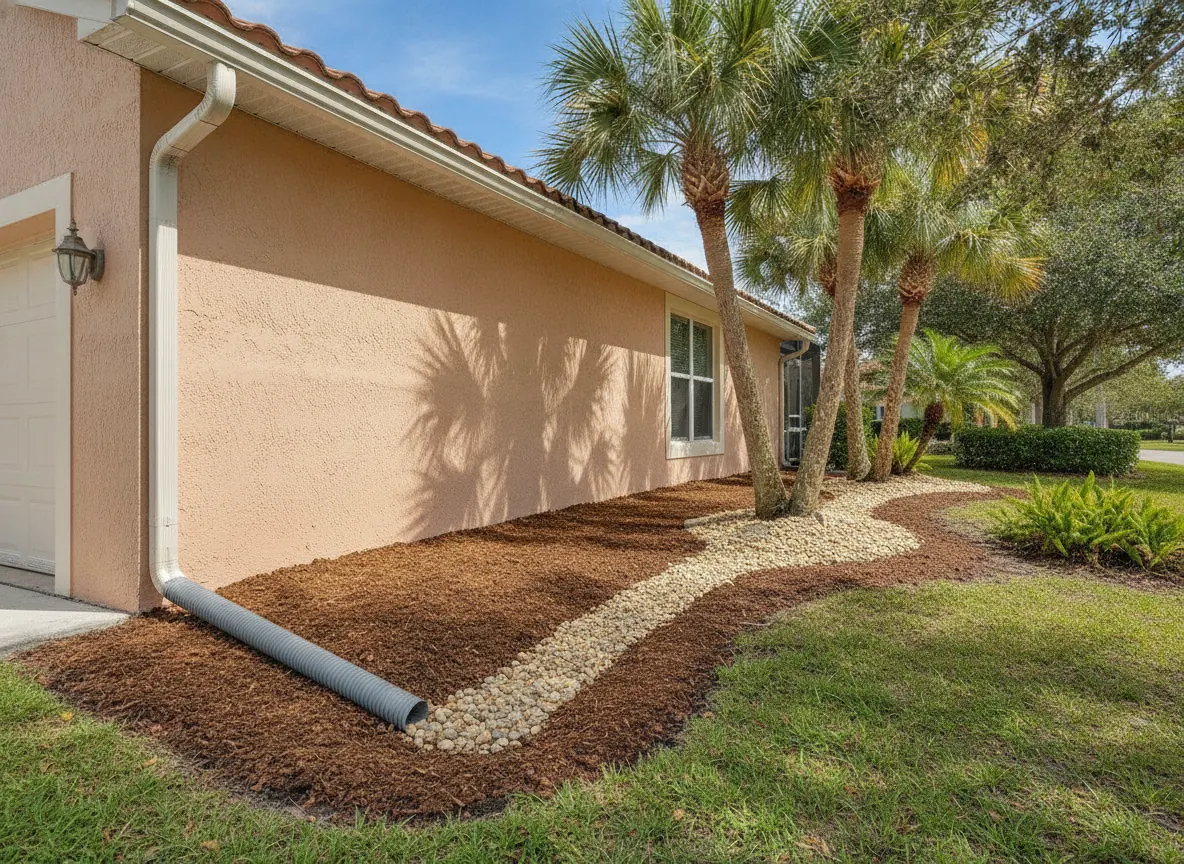
Downspout extension and regraded soil sloping away from a Florida home's slab

Water is the slab's main enemy on sandy lots

Central Florida homes have no basements to waterproof, so drainage work here is about something simpler: keeping water from washing sand out from under the slab edge and from soaking the soil the footings rest on. USDA NRCS data shows Orlando-area soils are mostly sands with negligible shrink-swell. Sand drains fast, but it also moves easily when concentrated water runs over or through it. A downspout dumping at the foundation, or a sprinkler head spraying the same spot every night, can carve a void under the slab edge over time.

Flatwoods soils such as Smyrna and Myakka add a second issue: NRCS describes Smyrna as poorly drained, with a water table within 18 inches of the surface for one to four months in most years. On those lots, standing water near the house is common in the wet months.

Orlando's rainy season by the numbers

NOAA 1991–2020 normals for Orlando International Airport.

NOAA 1991–2020 precipitation normals, Orlando International Airport
MeasureNormal
Annual precipitation51.45 in.
June–September29.57 in. (about 57 percent of the year)
Wettest monthJune, 8.05 in.
Driest monthNovember, 1.79 in.
Days with 1 in. or more15.0 a year

Storms push well past the normals. The National Hurricane Center recorded 13.2 inches at Orlando International during Hurricane Ian (Sept. 28–29, 2022) and 14.83 inches at an NWS cooperative site near Orlando during Hurricane Milton (Oct. 9–10, 2024). By contrast, 2026 has been one of the driest starts on record. Drainage problems often show up first after a heavy storm that follows a long dry spell, which makes the October–May dry season a practical time to evaluate and fix them.

Common drainage and grading fixes

Contractors and landscapers quote these, often alongside foundation work. They are simple in principle; the details are in the grade and the outlet.

Gutters and downspout extensions

Gutters collect roof water, and downspout extensions or buried pipes carry it several feet from the foundation to a spot where it can soak in or drain away. Splash blocks that dump at the slab edge are a common source of washout.

Regrading

Soil around the house is reshaped so it slopes away from the foundation instead of toward it. On sandy lots this often means bringing in fill and compacting it.

French drains

A gravel-filled trench with a perforated pipe intercepts water moving across or through the soil and carries it to a lower outlet, swale or approved discharge point. It needs somewhere to send the water, which can be the hard part on flat lots.

Slab-edge erosion and irrigation overspray

Voids at the slab edge are filled and the soil rebuilt, and sprinkler heads are adjusted, moved or replaced so they water the lawn instead of the foundation. If voids extend under the slab, foam lifting or other repair may follow; see slab foundation repair.

Drainage fixes stop new damage but do not reverse settlement that has already happened. If floors already slope or cracks are moving, see house leveling and piers and crack and block wall repair.

HOA review, permits and licenses

HOA and ARC approval: Florida's §720.3035 limits an association's architectural review to what its declaration states or reasonably implies. Regrading, new drains and visible exterior work may need architectural review committee (ARC) approval in some communities, so check your declaration before work starts.

Permits: Orange County says structural repairs to foundations need a permit, construction plans are required in most cases, and plans must be signed and sealed by a Florida PE or registered architect when repairs affect structural stability; a Notice of Commencement is required when work exceeds $5,000 (Orange County permit pages). In Seminole, Osceola and Lake counties and the cities, permit rules vary; the licensed contractor confirms and pulls any permit. Never assume drainage or grading work needs no permit.

Licenses: Repairing the slab or footing itself is foundation work. In Florida, structural foundation repair, underpinning and sinkhole stabilization of a house is Division I contracting: a certified or registered general contractor (CGC/RGC) or residential contractor (CRC/RRC) clearly qualifies, and a building contractor (CBC) arguably does for homes up to three stories (Fla. Stat. §489.105(3)(a)–(c)); Florida has no separate foundation or underpinning specialty license. Check any contractor's license number on MyFloridaLicense.com; a county business tax receipt is not a license.

We connect Orlando-area homeowners with independent Florida-licensed contractors for free, no-obligation foundation repair quotes. The contractor you choose quotes, contracts and does the work. Describe the water problem on the free quote form; we usually reply the same day. The Orlando soils guide explains more about sand and muck under local homes.

Foundation Drainage & Grading FAQ

Can poor drainage damage a slab foundation in Florida?

It can. Orlando-area soils are mostly sand with negligible shrink-swell (USDA NRCS), and sand washes out easily under concentrated water. A downspout or sprinkler that keeps hitting the same spot can erode soil from under the slab edge and leave a void. Directing roof and irrigation water away from the house is usually the first step before any slab repair.

When should drainage be fixed in Orlando?

Many homeowners schedule drainage work in the drier October–May window. NOAA 1991–2020 normals for Orlando International Airport show 29.57 of 51.45 inches a year falling June through September, with June the wettest month at 8.05 inches and November the driest at 1.79. Problems are easiest to diagnose right after a heavy rain.

Do I need a French drain or just gutter extensions?

Often extensions and regrading are enough, because roof runoff landing at the foundation is the most common source of slab-edge washout. A French drain helps when water moves across the lot from a neighbor or slope, or the yard stays wet near the house. It needs a lower outlet to discharge to. A contractor can judge which fits after seeing the lot in rain.

Does my HOA need to approve drainage or grading work?

It may. Florida's §720.3035 limits an association's architectural review to what its declaration states or reasonably implies, and regrading, new drains or visible exterior changes can fall within that in some communities. Check your declaration and ask the association before work starts. Permit rules are separate and vary by jurisdiction; the licensed contractor confirms and pulls any permit.

Cracked slab, sticking doors or a new depression in the yard? Get a clear quote.

Free, no-pressure quotes across Orlando, Winter Park, Kissimmee, Sanford, Altamonte Springs and Central Florida.

Call NowFree Quote